Home Security
Smart CCTV & IP Camera Systems
High-resolution surveillance that works with the rest of your home. Live views on any screen, intelligent motion detection, secure local recording and instant alerts wherever you are.
Modern IP Cameras vs Traditional CCTV
The grainy, timestamped footage most people picture when they hear "CCTV" belongs to analogue systems that recorded to a box in a cupboard and were reviewed only after something had already happened. Those systems still exist, and they are still being sold. They are not what we install.
An IP camera system runs over your home network. Each camera is effectively a small computer producing a high-resolution digital stream, which means detail that holds up when you zoom in, footage you can review from anywhere, and — crucially — the ability to make decisions about what it is seeing rather than simply recording everything indiscriminately.
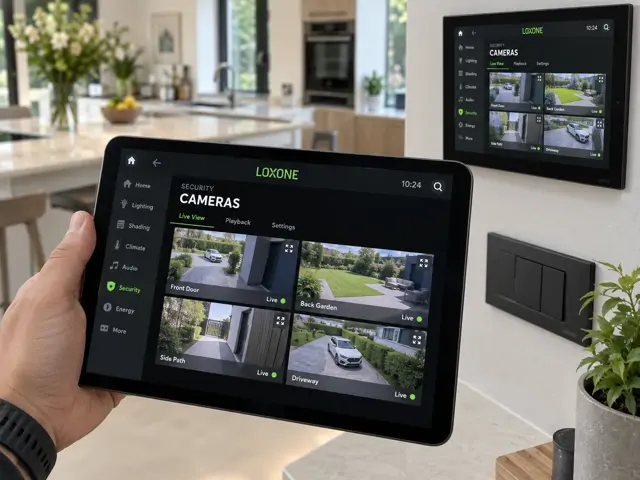
The real advantage arrives when that home surveillance system stops being a separate installation and becomes part of your smart home. Cameras that can talk to your Loxone system can trigger lights, appear automatically on the nearest screen when someone approaches, and attach a snapshot to the alert that reaches your phone. That is a genuinely different proposition from a set of cameras and a recorder.
What You Gain From an IP System
The practical differences between a modern home CCTV installation and a legacy analogue system show up in everyday use rather than on a specification sheet.
Camera Types & Placement
Choosing the right home security camera for each position matters far more than buying the highest specification available and mounting it wherever the cable happens to reach. Coverage planning is the part of the job that determines whether a system produces useful footage or an expensive archive of empty driveways.
External Bullet & Turret
Weather-rated fixed cameras covering approaches, driveways, side access and garden boundaries. Turret cameras handle infrared night vision particularly well because the illuminator sits away from the lens, avoiding the glare that plagues cheaper units.
Internal Cameras
Discreet indoor cameras for entrance halls, garages, plant rooms and outbuildings. These can be set to disable automatically whenever the house is occupied, so the family is never being filmed inside their own home.
Doorbell Cameras
We most often specify DoorBird for its build quality, wide field of view and clean Loxone integration. It handles two-way audio, works as an intercom, and can release a door or gate directly.
PTZ Cameras
Pan-tilt-zoom units cover large plots, paddocks and long driveways from a single position. They can be driven manually from the app or set to move to a preset view automatically when another sensor is triggered.
Discreet Placement
Cameras recessed into soffits or colour-matched to the building fabric, positioned to cover what matters without dominating the elevation — particularly important on period and listed properties.
Visible Deterrence
In some positions you want the camera to be seen. A visible unit at the point of approach discourages the opportunist entirely, which is a better outcome than recording them clearly.
Planning Coverage for Your Property
Different property types call for different approaches. A townhouse or terrace usually needs tight coverage of a small number of entry points — front door, rear access, and any side return. A detached property with grounds benefits from a layered approach: a boundary layer that provides early warning, an approach layer covering the driveway and paths, and a building layer at the doors and vulnerable windows.
Rural and equestrian properties introduce outbuildings, stables and machinery stores that are often further from the house than the house is from the road, and these usually need their own network infrastructure. Multi-occupancy properties, meanwhile, have to balance security with tenant privacy — common areas and entrances are covered, private space is not. We work through all of this at survey stage and produce a camera plan before any equipment is ordered.
Smart Camera Features
The smart camera features below are what make the difference between a system you check occasionally and one you actually rely on.
Person & Vehicle Detection
On-camera analytics classify what has moved before deciding whether to alert you. A person crossing the driveway matters; a fox, a bin bag in the wind and heavy rain do not.
Motion-Triggered Recording
Continuous recording at a lower rate with a switch to full quality on detection. You keep a complete timeline without filling storage with hours of an empty garden.
Zone Masking
Detection areas are drawn precisely, so a camera covering your driveway ignores the pavement and the neighbour's parking space entirely. Fewer false alerts, and better privacy compliance.
Night Vision
Infrared and low-light modes maintain usable detail after dark. Where the system also controls external lighting, we can bring lights up on detection to capture full-colour footage instead.
Two-Way Audio
Speak through a doorbell or camera from your phone. Useful for redirecting a courier, and remarkably effective at moving on anyone who did not expect to be spoken to.
Live Viewing via App
Remote CCTV viewing from anywhere, with all cameras in one place alongside the rest of your home controls rather than in a separate manufacturer app.
Local NVR Storage
A network video recorder on site keeps footage under your control, records through an internet outage, and avoids the ongoing cost of cloud subscriptions scaled per camera.
Cloud Backup
Optional offsite copies of key events protect against the recorder itself being stolen or damaged. We typically pair local recording with selective cloud backup rather than choosing one or the other.
Capacity is sized around camera count, resolution and how far back you want to be able to look. Two to four weeks of retention suits most households; we will size it properly rather than guessing.
Integration with Your Smart Home
Standalone cameras ask you to remember they exist. An integrated camera system brings the right footage to you at the moment it becomes relevant, which is the entire point of CCTV smart home integration.
Camera Feeds on Any Screen
Live views appear on wall-mounted touch panels, tablets and televisions throughout the house. When the doorbell rings, the feed can interrupt whatever is on the nearest screen so you can see who is there without getting up - genuinely useful in a large house, and more so for anyone with limited mobility.
Motion Triggering Lights
Person detection on an external camera can bring up the driveway lighting, illuminate the path to the door, or switch on a hall light so the house does not look empty. Because Loxone handles both the camera event and the lighting, this happens in under a second and needs no third-party bridge.
Alarm-Triggered Recording
When the alarm system escalates, cameras raise their recording quality, bookmark the timeline and push a snapshot to your phone with the notification. You get context immediately instead of a bare alert telling you a sensor was triggered.
Unified Timeline Review
Camera events sit alongside door openings, alarm states and access-control activity in one chronological view. Working out what happened while you were away becomes a two-minute job rather than an afternoon of scrubbing through footage.
Domestic CCTV that captures anything beyond your own property boundary brings data protection obligations with it under UK GDPR. In practice this is straightforward to manage: careful camera angles, privacy masking applied to neighbouring gardens and public pavement, sensible retention periods and clear signage. We handle this as part of the design so your system is both effective and compliant, and we will tell you if a camera position you have asked for is likely to cause problems.
Our CCTV Projects
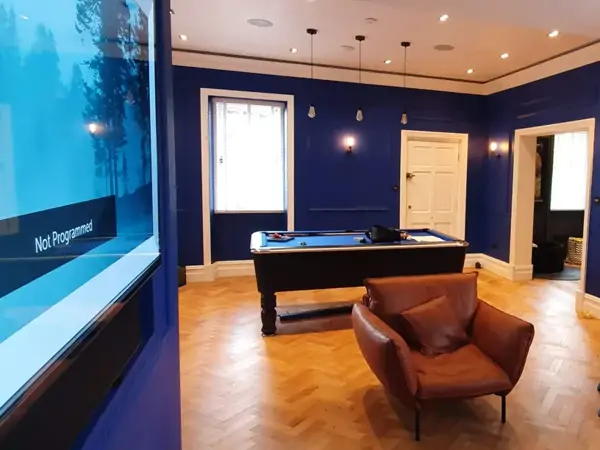
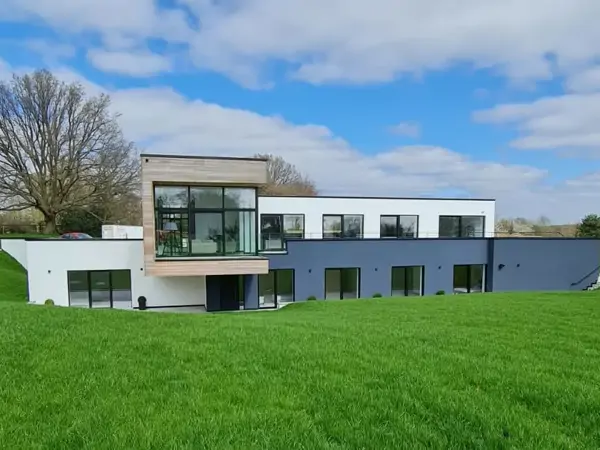
Camera systems form part of most of the whole-home installations we complete. These projects show the range, from compact urban properties through to multi-building sites with grounds to cover.
Common Questions
CCTV Questions
How many cameras does a typical home need?
Most family homes are well served by four to eight cameras. A three-bedroom semi might need four — front approach, rear garden, side access and a doorbell camera. A larger detached property with a driveway, outbuildings and multiple entrances typically lands between eight and twelve. The number matters less than the positioning, and we would always rather install six well-placed cameras than twelve badly aimed ones.
Can cameras be added to a house that is already built?
Yes. Retrofit camera installation is something we do regularly. External cameras are often the easiest element to add because cabling can frequently be routed externally along soffits and under eaves, or brought in through a loft space. Where running Cat6 to a particular position genuinely is not feasible, we can use wireless cameras for that location while keeping the rest of the system wired.
Will I get constant notifications on my phone?
Only if the system is set up badly. Person and vehicle classification, carefully drawn detection zones and time-based rules mean you can choose exactly what warrants an interruption. A common configuration alerts on anyone approaching the front door at any time, but only alerts on garden movement overnight. We tune this with you after handover once you have seen how the system behaves in practice.
Where is my footage stored, and who can see it?
By default, on a network video recorder in your own property. Access is controlled through your smart home system with individual user accounts and permission levels, so you decide who can view live feeds and who can review recordings. If you choose to add cloud backup, we will be explicit about what is stored offsite and for how long.
Do the cameras still record if my broadband goes down?
Yes. Cameras, the recorder and the Loxone Miniserver all communicate over your local network, which continues to operate independently of your internet connection. Recording, motion detection and any automated responses such as lighting activation carry on as normal. The only thing you lose during an outage is remote viewing from outside the house, which resumes automatically once the connection returns.